


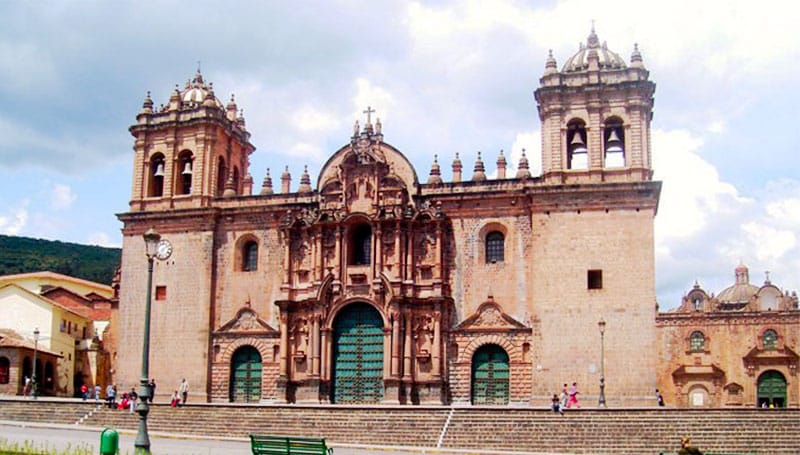
The Cusco Cathedral, or Basilica of Our Lady of the Assumption, located in the Plaza de Armas, is one of the city’s most important historical and religious monuments. It was built in 1559 on the site of an ancient Inca palace and combines Renaissance, Baroque, and Andean styles. Inside, visitors can find works from the Cusco School that reflect the blend of Inca and Spanish cultures—such as *The Last Supper with Guinea Pig*—as well as the region’s rich artistic heritage.
What is the Cusco Cathedral?
It is the city’s most important Catholic church and the site where major religious festivals are celebrated. Its architecture combines Renaissance, Mannerist, and Baroque elements. It is flanked by two bell towers; the side portals are Mannerist, and the central one is in a subtle Baroque style.
The cathedral was built on the site of the ancient Suntur Wasi, the palace of the Inca Wiracocha.
Where is the Cusco Cathedral?
The Cusco Cathedral is located in the Plaza de Armas, in the city’s historic center. Its central location makes it a key spot for exploring the city’s cultural and religious heritage. Surrounded by colonial buildings and tourist attractions, it is a must-see destination. Most visitors can walk there from downtown. If you’re in a more remote area, taking a taxi is an option.
History of the Cusco Cathedral.
In the Inca Empire, what is now the historic center of Cusco was the political, religious, and administrative heart of the Tahuantinsuyo. Where the Cathedral now stands was once the site of the Kiswarkancha Palace, whose name means “courtyard of the quiswar,” referring to a tree native to the Andes (Buddleja incana) that likely adorned the site and was associated with the Inca Wiracocha. The Plaza de Armas, known as Huacaypata, was a key site for ceremonies and public events.
The arrival of the Spanish (1533–1559) marked a period of urban transformation and the introduction of Christianity. In 1536, the Diocese of Cusco was established, and construction began on a cathedral. Initially, the main church stood where the Church of El Triunfo stands today. Later, the site of the former Kiswarkancha palace was chosen for the construction of a larger cathedral, It was built between 1560 and 1654. It is shaped like a Latin cross.
During the colonial era: Construction began in 1560, initially supervised by Juan Miguel de Veramendi. Several architects and master builders participated in its construction. Andesite stones and materials from Sacsayhuamán were used to build its walls. An earthquake in 1650 damaged parts of the temple, but the cathedral largely survived. As a result, the third section of the towers was lowered to make them appear more solid and stable. The main construction work was completed in 1654 under the direction of Miguel Gutiérrez Sencio.
The Sagrada Familia church, part of the cathedral complex, was begun in 1723 under the direction of Gabriel de Arregui. Upon the architect’s death, work resumed in 1733, and the church was consecrated on September 3/ 1735.
After Peru gained independence, the Cathedral remained an important center of religious and cultural life in Cusco. Its altars, chapels, sculptures, and paintings were preserved as a fundamental part of the city’s artistic heritage. Over time, maintenance and conservation work was carried out to protect the structure and the works of art.
Contemporary Era and Today: Today, the Cusco Cathedral is one of Peru’s best-known historical and religious monuments.
In 1928, the Catholic Church designated it a minor basilica. Since 1972, it has been part of the Cusco Monumental Heritage Area. In 1978, Juan Carlos I presented a portion of the ashes of Inca Garcilaso de la Vega to the Church of the Triumph.
In 1983, UNESCO designated Cusco a World Heritage Site, including its Historic Center, where the Cathedral is located.
The Legend of Santiago, Known as “Mataindios”
The legend of Santiago, known as “Mataindios,” is linked to the Spanish conquest of Cusco and the arrival of Christianity in the Andes.
According to colonial tradition, in 1536, during Manco Inca’s rebellion, the Spaniards were surrounded in Cusco and found themselves in a difficult situation.
According to tradition, during the Siege of Cusco, Inca warriors fired flaming arrows that set the thatched roofs of the Kiswarcancha complex ablaze. The roof of the Suntur Wasi either did not burn or the flames mysteriously went out. The Spaniards believed their salvation was the work of God: they claimed to have seen the Virgin of the Descent—later called the Virgin of Triumph—extinguishing the fire, and a mysterious horseman appeared in the sky, dressed in white, riding a white horse, and wielding a shining sword. The Spaniards identified him as Saint James, fighting against the indigenous people.
After the siege, the Spanish destroyed much of both structures. In 1539, they used the ruins of the Suntur Wasi to build the first cathedral in Cusco, now called the Church of the Triumph. Many historians view this action as the imposition of the Catholic religion on Inca culture.
Legend has it that, while the Incas were attacking the city, they believed that a miracle had intervened to save them.
However, this is part of a colonial religious tradition and not a verifiable supernatural event.
Main Attractions at the Cusco Cathedral
The Cathedral of Cusco has three naves—the Epistle nave, the Gospel nave, and the central nave—which correspond to the three doorways on the façade. Furthermore, the cathedral’s Gothic-Renaissance style reflects that of Spain during the period of the Spanish conquest of South America, as well as the style prevalent in Cusco at the time. Consequently, the Cathedral of Cusco can also be considered one of the most important museums in the city; Its main attractions include:
Colonial architecture: The choir, made of cedar wood, features ornamental motifs in the colonial style.
The High Altar: The cathedral houses two different high altars, facing each other. The oldest is located against the wall at the north end of the central nave. It is an altarpiece carved from labran (alder) wood. The second stands out for its decoration and silver ornaments.
The sacristy next to the high altar. This is where priests prepare before any ceremony and where religious objects are kept. There is a beautiful Baroque altarpiece made of cedar wood, featuring an image of Christ on the cross, the work of Alonso Cano, a Spanish artist. The walls display portraits of all the bishops of Cusco, beginning with Vicente de Valverde. These portraits reflect the local style known as “the Cusco School.”
Silverware Gallery: The metallurgical wealth of the Viceroyalty of Peru is on display in the Silverware Gallery, where the treasures of the Cusco Cathedral are kept. These works were crafted by renowned Spanish and indigenous artisans. Among them are a silver float used in the Corpus Christi celebration, monstrances, chalices, and gold and silver accessories.
The María Angola bell, famous in Cusco, was cast in 1659 by Diego Arias de la Cerda at the request of Bishop Diego de Ortega y Benavides. It measures more than two meters and weighs nearly 5.6 metric tons. According to legend, an African woman named María Angola donated her gold and diamond jewelry to give the bell its distinctive sound. It is located in the Cathedral’s Gospel Tower and is rung only on special occasions to protect it.
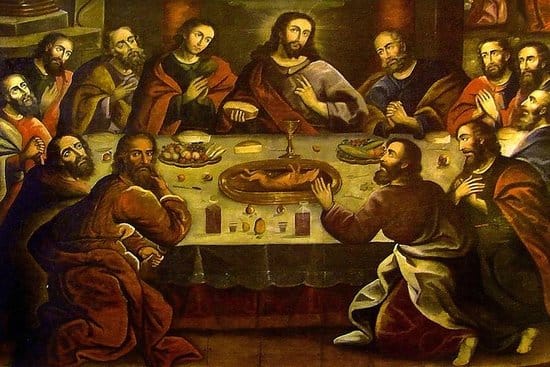 The Cusco School emerged during the colonial era, combining European Renaissance and Baroque techniques with Andean elements. Quechua painters were restricted to depicting only scenes from the Catholic Church. The constraints imposed upon these Inca-descended artists prevented them from signing their own works—rendering many of them anonymous—yet they still managed to incorporate Inca landscapes, symbols, and influences. The paintings housed in the Cusco Cathedral serve as an example of this cultural and artistic fusion; the collection consists of canvases from the Cusco School.
Among the indigenous Cusco painters of that period, one of the most renowned is Diego Quispe Tito (1611–1681), known for his famous ‘Zodiac’ series in the Cusco Cathedral. Other notable works adorning the cathedral include: ‘The Virgin with the Little Bird’ (by Bernardo Bitti), the canvas of ‘Our Lady of Almudena’ (by Basilio Santa Cruz Pumacallo), the series depicting ‘Saint Luke, Saint Mark, Saint John, and Saint Matthew’ (by Antonio Sinchi Roca), ‘The Last Supper’ (by Marcos Zapata), as well as pieces by Basilio Pacheco, and others.
The painting “The Last Supper” adorns the cathedral’s walls alongside canvases from the colonial Cusco school. Of particular note is this 5-by-4-meter work by Marcos Zapata, which replaces elements of the original painting with Andean symbols, such as the vizcacha—an animal considered the guardian of lakes and mountains.
Altars, chapels, and works of art: The Cathedral features naves, 14 side chapels, altars, that house various works of art religious art. , including statues of saints and the Virgin Mary, as well as paintings.
Choir stalls: This is one of the cathedral’s most notable features, located at the lower end of the central nave. It is made of solid cedar and features a “neo-archaic” style, common in Spain between the 15th and 17th centuries. It is divided into three sections: the side sections have seats in two rows, while the center section has a single row. Of particular note are the backrests attached to the walls, featuring relief carvings depicting figures of saints.
The Lord of the Earthquakes is the most venerated image and the patron saint of Cusco. Traditionally, he is credited with protecting the city during the 1650 earthquake. Also noteworthy is the Chapel of Our Lady of the Assumption, famous for a painting depicting the Virgin Mary surrounded by angels.
Many of the details are gilded, and the walls feature religious paintings and sculptures. One of the sculptures most revered by the people of Cusco is the Lord of the Earthquakes.
The church houses an important collection of colonial paintings by indigenous, mestizo, and European artists.
What is there to see in the Cusco Cathedral?
The Sacristy – The sacristy is one of the most notable rooms in the Cathedral. It is located to the right of the main altar. Its walls are adorned with portraits of all the bishops of Cusco, from Vicente de Valverde (1499–1541) to the most recent ones.
The Lord of the Earthquakes (El Señor de los Temblores) – This statue of a dark-skinned crucified Christ is an emblem of the Cathedral.
It is widely believed that the statue mitigated the damage caused to the city during the earthquake of 1650.
The piece is crafted from a variety of mixed materials, including wooden supports, agave fiber, and plaster.
The Choir Stalls – The choir stalls are a must-see in the Cusco Cathedral. Constructed in the Plateresque or “neo-archaic” style—prevalent in Spain between the 15th and 17th centuries—they are made entirely of cedar wood.
The Last Supper – This depiction of the Last Supper was painted by Marcos Zapata in 1753.
The large-scale painting shows Jesus and the twelve apostles gathered around a table, preparing for a meal whose main course is a roasted guinea pig (*cuy*).
The Silver Room – This is a small side chapel that houses a diverse collection of religious objects crafted from gold, precious stones, and, most notably, silver.
Hours and Admission Prices
Visiting Hours: Daily, from 10:30 a.m. to 5:00 p.m.
Mass: Daily, from 7:00 a.m. to 10:00 a.m.
Prices:
Foreign adults: S/ 45.00.
Foreign students: S/ 20.00.
Where can I buy tickets?
Tickets can be purchased at the main entrance of the Triunfo Church, located next to the cathedral on the left side.
Address: 122 Triunfo Street, Historic Center of Cusco, Peru.
You must show your passport as identification.
You can pay in soles or by credit card. If you are traveling with minors, bring a document proving their age.
Best Time to Visit
We recommend visiting the
Cathedral Basilica between 10:00 a.m. and 11:30 a.m. until 4:00 p.m. During
that time, you’ll be able to explore its spaces with far fewer people and enjoy
the morning light, which magically filters into the vestibule and illuminates
the interior, even though it’s an enclosed space.
Visitor Guidelines
If you visit the Cusco Cathedral, please keep the following guidelines in mind:
Please remain quiet inside the church.
Please do not touch the works of art.
Photography and video recording are prohibited inside the cathedral.
What to Visit Near the Cusco Cathedral
The Cusco Cathedral is located in the Historic Center, an area full of attractions to enjoy after visiting the cathedral.
Plaza de Armas: This is the lively heart of the city, surrounding the cathedral. The surrounding buildings feature colonial arcades with carved wooden balconies. In the center stands a fountain with a statue of the Inca.
Church of the Society of Jesus: It is located across from the plaza, on its south side.
Its façade, in the Andean Baroque style, is one of the most striking on the continent. Inside, there is a main altarpiece entirely covered in gold leaf, as well as works from the Cusco School. You can also climb up to the choir, where you’ll have a unique view of the plaza.
The 12-Angled Stone: It is located two blocks from the plaza, up the Hatun Rumiyoc pedestrian street.
It is an example of extraordinary Inca engineering and masonry. The stone is part of the wall of the Inca Roca Palace—now the Archbishop’s Palace—and its twelve corners fit perfectly with the surrounding stones, without the use of glue or mortar.
Plazoleta Nazarenas: Less than a five-minute walk uphill from the Palace lies this peaceful cobblestone square. It is one of the most charming and tranquil colonial squares in the historic center, surrounded by old colonial buildings of great architectural value that now house prestigious hotels and museums.
Frequently Asked Questions
a) Where can I buy tickets for the cathedral?
Tickets for the cathedral can be purchased at the cathedral’s own entrance.
You can also purchase a ticket for the Cusco Religious Circuit, which includes a visit to the Cathedral, as well as the Church of San Blas, the Church of San Cristóbal, and the Archbishop’s Museum.
b) Which excursion should I take to visit the Cusco Cathedral?
The most highly recommended excursion for visiting the cathedral is the city tour, which covers two major attractions: Qoricancha and the Cusco Cathedral.


